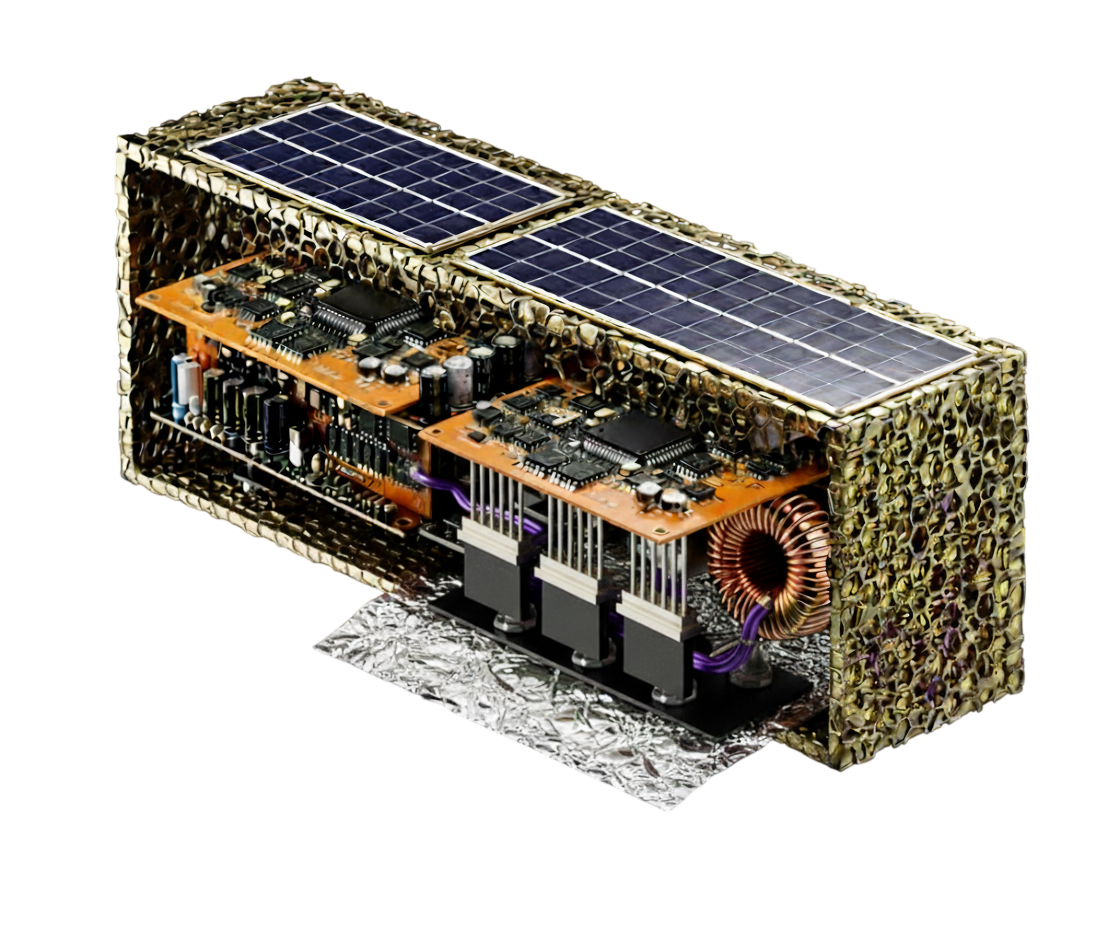
The Thermal Cut-off.
High-power X-band SAR radars overheat rapidly in a vacuum. Current thermal limits force automatic session cut-offs (60-100 seconds max), capping data collection revenue.
Cryogenic power architecture for microsatellites. We cool power electronics down to -100°C to eliminate thermal bottlenecks, double radar uptime, and slash mass penalties.
Request Pilot IntegrationIP Licensing & Custom Architecture Design
High-power X-band SAR radars overheat rapidly in a vacuum. Current thermal limits force automatic session cut-offs (60-100 seconds max), capping data collection revenue.
Pushing more power requires massive radiators and heavier batteries. Every extra kilogram costs thousands in launch fees and eats into payload capacity.
Standard solid-state converters waste up to 15% of energy as parasitic heat. In a closed vacuum environment, this inefficiency is a critical liability.
By isolating the power conversion loop and cooling it to -100°C (173 K), we suppress phonon scattering in the semiconductor lattice.
Drag the node to allocate your thermal reserve. Base platform: 350kg SAR Microsatellite.
Royalty per unit.
NRE (Non-Recurring Engineering).
Priority access to architecture updates and support.

The architecture is developed by Mikhail Ostapchuk — a PhD student and engineer at Moscow Aviation Institute (MAI) whose research on cryogenic power semiconductors was selected among the top 100 projects of the NTI platform. With 5 years of startup experience — including customer development with major industrial players — and an extensive engineering network across Russian aerospace, he brings both deep technical expertise and the capability to deliver.
Read the underlying physics:
We are currently selecting partners for our upcoming pilot program and IP licensing.